Atherton Minimum Lot Size: Guide to Zoning Laws and Rules
Schedule a free consultation to learn how Atherton minimum lot size rules protect property values in zip code 94027. Call Robert Parish today.
July 6, 2026 · 15 min read · Property guides
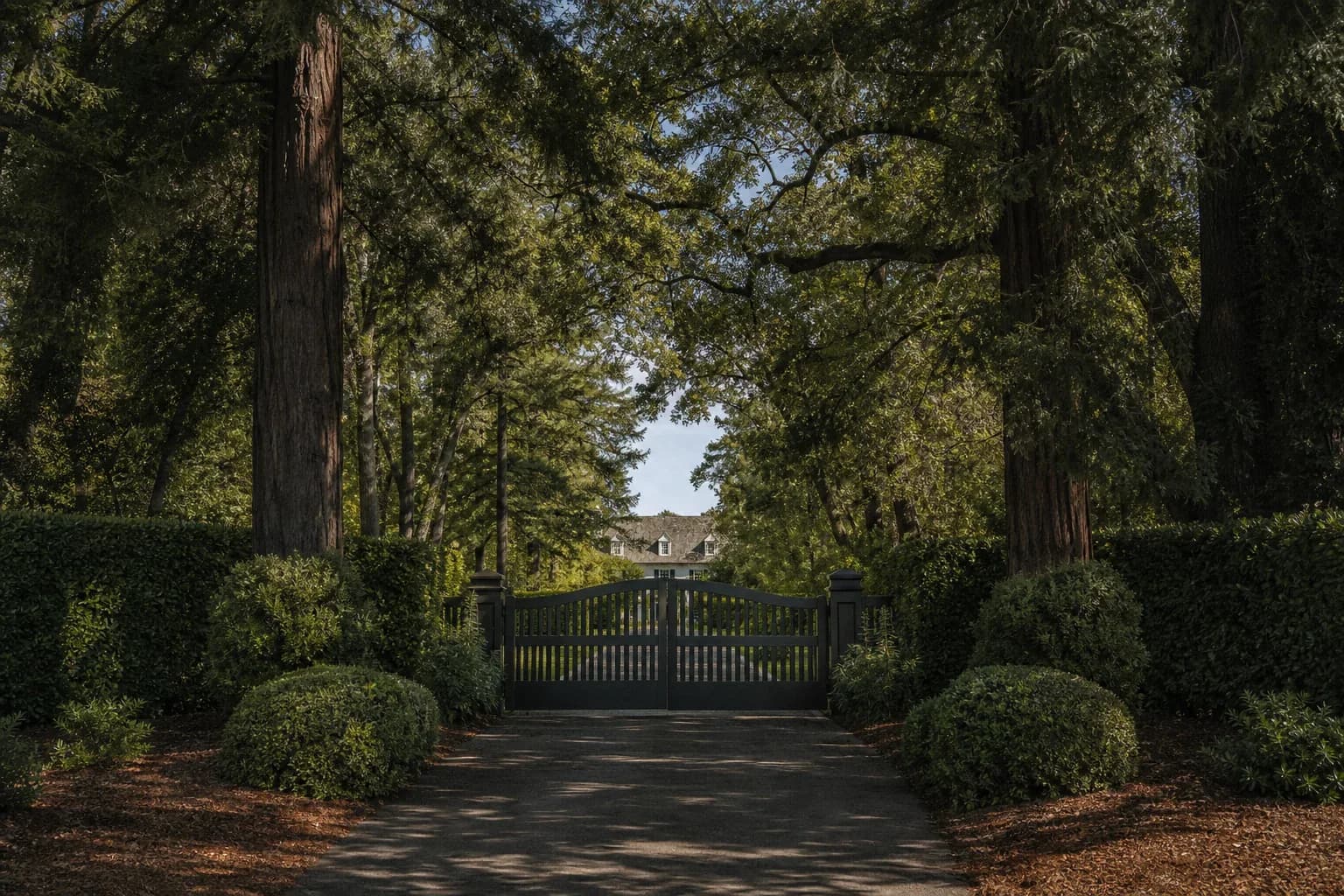
Atherton has held the title of America’s most expensive zip code (94027) for eight consecutive years. The reason is not just the grand estates or the Silicon Valley proximity. It is a zoning rule that has stayed in place for decades: the minimum lot size. Atherton requires most residential lots to be at least one acre. This one rule shapes everything else about the town. It limits how many homes can exist. It creates deep buffers between neighbors. It sets a high price floor under every property. For buyers seeking the ultimate privacy in the Peninsula, understanding this rule is the first step toward making a sound investment.
Ready to buy or sell in Atherton? Call Robert Parish at 650-400-1011 to discuss how zoning rules affect your real estate goals.
One acre equals 43,560 square feet. In most Peninsula suburbs, lots are measured in thousands of square feet, not acres. In Atherton, the acre is the baseline. The town’s zoning code divides the land into two residential zones: R-1A for estate lots and R-1B for smaller parcels. The R-1A zone requires a minimum of one acre for new lot subdivisions. Steeper terrain demands even more land. Slopes between 20 and 35 percent require two acres, and slopes above 35 percent require five acres. These rules apply to new lot creation, not to existing lots that predate the codes. If a lot was valid when created, it remains a valid building site.
Atherton Minimum Lot Size: What Is Atherton’s Minimum Lot Size Requirement?
The R-1A zone is the standard for most of Atherton’s 3,600 acres. Under this designation, new lots must measure at least one acre, or 43,560 square feet. This rule applies to slopes under 20 percent. For steeper terrain, the requirements escalate. Slopes between 20 percent and 34.9 percent require a minimum of two acres. Slopes of 35 percent or more require five acres. These slope-based tiers protect the natural landscape while limiting density on fragile terrain.
The R-1B zone serves a different purpose. It allows lots as small as 13,500 square feet, roughly one-third of an acre. This smaller minimum applies to specific areas of town and offers more flexibility. But even R-1B enforces a low-density feel compared to most Peninsula communities.
For context, Atherton spans about 5.02 square miles and holds roughly 7,188 residents. That density is extraordinarily low for a town inside the Silicon Valley corridor. By comparison, Palo Alto has nearly 10 times the population within a similar land area. The minimum lot sizes are the primary tool keeping Atherton’s population low and its land values high.
Existing lots that do not meet current minimums are protected by the code. The municipal code states that parcels meeting prior minimum zoning standards shall not be deemed substandard by the adoption of new rules. This grandfathering protects owners of older, smaller lots from losing their building rights. To explore specific properties and their zoning designations, explore Atherton real estate listings and market data.
How Does the One-Acre Minimum Preserve Property Values in Atherton?
Scarcity and the luxury price floor
Atherton’s one-acre rule creates a small supply of land for homes. This zoning law makes each parcel worth much more because new lots are rare. Most buyers know zip code 94027 as the most costly in the country. The town has held this top rank for eight years in a row. With a median home price now over $8 million, the market shows that land size drives cost. Our review of Atherton real estate market trends tracks how those figures have moved. Large lots prevent the town from getting too full. This helps the market stay strong and stable for all owners. The tight supply ensures that demand for land remains high among the world’s most wealthy people.
The one-acre minimum creates a type of scarcity that supports land worth over time. When there are fewer homes to buy, each home becomes more unique. This is a key part of how the town keeps its status. By keeping the density low, the town ensures that each estate remains a private retreat. This plan has proven to be a long-term win for the local real estate market. Robert Parish focuses on these details while helping clients create equity with every transaction.
Privacy through low density and setbacks
The town uses zoning to keep a quiet, semi-rural feel. Large lots mean fewer houses and more green space for every person. Current land use rules keep density low across the town’s 3,600 acres. These laws help protect the natural beauty of the Peninsula. Setbacks also play a big role in how much a property is worth. Most large estate lots must have 60-foot front and rear buffers. These large gaps create deep privacy between neighbors. They also allow for grand lawns, long drives, and tall oak trees.
These deep setbacks prevent the feeling of being boxed in. In other towns, homes may be built much closer to the street or each other. In Atherton, the space between houses is a luxury feature itself. This quiet feel is why many top tech leaders and founders choose this area. Buyers pay a premium for the peace that comes with such large property lines. These zoning rules act as a shield for your investment. They ensure that your neighbor cannot build right up to your fence line. For a deeper look at what drives home prices in this exclusive market, read our analysis of Atherton home valuation factors.
Building scale and the floor area ratio
Building rules also limit the size of a home relative to the lot size. The floor area ratio, or FAR, is capped at 18 percent for most large lots. This rule prevents any single house from taking up too much of the soil. By limiting the buildable area, the town ensures that all estates look balanced. This 18 percent cap protects Atherton home values by stopping overbuilding. It keeps the town from losing its open, park-like feel.
When every home has enough space, the whole town keeps its high-end look. A massive home on a small lot can sometimes hurt the value of a street. Atherton avoids this by making sure every house has a proper setting. The FAR cap works with the lot size rules to keep the town’s scale in check. This balance is rare in the Silicon Valley region. It provides a level of safety that wealthy buyers value. You can buy a home here knowing the area’s look will not change overnight. These laws keep the town’s character safe for decades to come.
Atherton’s Residential Zones: R-1A and R-1B Compared
Atherton divides most of its land into two main residential zones. The R-1A zone covers the large estate lots that define the town’s feel. The R-1B zone allows for smaller parcels while still keeping a low-density look. Both zones use rules to limit how much you can build on a lot. These rules focus on the floor area ratio (FAR), which is usually 18 percent for lots that are one acre or larger.
Zoning rules for estate lots
Most land in Atherton falls under R-1A rules. This zone needs a one-acre minimum lot size for new land splits. Large setbacks create deep buffers between homes and the street. These gaps help keep the town quiet and private. You must place your home at least 60 feet from the front and rear property lines. Side yards must be at least 50 feet wide to meet the code.
The R-1B zone offers a different set of rules for smaller parcels. These lots must be at least 13,500 square feet. Because the lots are smaller, the setbacks are also shorter to allow for a fair building area. You only need a 30-foot front yard and a 26-foot side yard in this zone. The table below shows the key differences between these two residential districts.
| Requirement | R-1A (Estate) | R-1B (Residential) |
|---|---|---|
| Min Lot Size | 1 Acre (43,560 sq ft) | 13,500 sq ft |
| Front Setback | 60 Feet | 30 Feet |
| Side Setback | 50 Feet | 26 Feet |
| Rear Setback | 60 Feet | 30 Feet |
| Max Height | 30 Feet | 28 Feet |
| Base FAR | 18 Percent | 18 Percent |
Formulas for smaller parcels
Atherton uses a special math rule for lots that do not meet the one-acre mark. This ensures you can still build a home that fits the land size. The town finds floor area as the lot size times 0.163 plus 726 square feet. This math gives owners a minimum floor area of at least 2,250 square feet. This rule helps owners of older or unique lots plan their work with clear limits.
Some land owners may worry if their current lot does not meet the new size rules. Atherton law protects these older sites. If a lot met the old rules when it was made, it stays a valid building site. This zoning protection means you do not lose your right to build just because the town changed its rules. You can still use these lots for your home if you follow the rest of the code.
Buildable Area: Setbacks, FAR, and the Envelope
Atherton land use laws create a tight frame for new homes. Even on a full one-acre parcel, you cannot build on every square foot. Rules for setbacks and floor area limits define the buildable envelope. These laws ensure every estate feels private and open. Knowing these bounds is vital before you start a project or buy a lot.
Setbacks and the buildable rectangle
The town uses deep setbacks to keep homes far from the street and neighbors. In the R-1A district, you must keep 60 feet of space from the front and rear property lines. Side yards must be at least 50 feet wide. These rules create a buildable rectangle in the center of your lot. Any structure over six feet high must stay within this box. You can see more on Atherton zoning code for specific lot shapes.
These gaps do more than provide privacy. They create the classic Atherton look of large homes set back in lush woods. You can use some of this space for low fences or small paths. But major building work is barred from these buffer zones. This keeps the low-density feel of the town intact for all residents.
Floor area and height limits
Atherton limits how much total home you can build. The floor area ratio (FAR) is usually capped at 18 percent for one-acre lots. This means a 43,560 square foot lot can hold a home of about 7,840 square feet. This cap counts all floors but often excludes basements. It prevents massive homes from crowding the land and blocking light or views.
The town also sets a 30-foot height limit for main homes. This usually allows for two full stories plus a high roof. Lower limits may apply to smaller lots or specific zones. Most estate builders find this height enough for grand entryways and high ceilings. Keeping homes lower to the ground helps the town blend into the natural landscape.
Protected trees and site costs
Nature often dictates where you can build on your land. Atherton has strict rules to save its native trees. Any oak with a trunk circumference of 48 inches or more is protected. You must plan your build around these trees. Removing one requires a permit and often a good reason. This rule adds to the charm of the area but narrows your site options.
Building in this market comes with high costs. Most custom homes in Atherton cost between $500 and $1,000 per square foot to build. This price covers high-end finishes and site prep. When you factor in the 1,200 square foot limit for detached guest houses, your total space grows. Understanding Atherton home values involves balancing these costs with the land’s potential.
Lot Splits and SB 9 in Atherton: What Options Do Property Owners Have?
SB 9 is a state law that allows certain single-family lots to be split into two parcels. In theory, this could increase density in Atherton. In practice, the law is tightly constrained by local conditions and the municipal code. For a broader view of how Peninsula luxury markets compare, explore how nearby communities use zoning differently.
- Check eligibility. The property must be zoned for single-family use. Most of Atherton qualifies. But the parcel must also meet minimum area standards that SB 9 does not override.
- Apply the 40 percent rule. The Atherton municipal code requires that one resulting parcel be at least 40 percent of the original lot area. On a standard one-acre lot (43,560 sq ft), that means one parcel must be at least 17,424 square feet. The other can be as small as 1,200 square feet.
- Verify the minimum parcel size. No resulting parcel may be smaller than 1,200 square feet. This is well below the R-1A minimum of one acre, but the state law creates a separate path that does not require compliance with local subdivision standards.
- Assess feasibility. For a standard one-acre lot, SB 9 does not meaningfully enable a split. The resulting parcels would be far smaller than the estate-scale lots that define Atherton’s character. The law is most relevant for larger parcels of two acres or more, where both resulting lots could approach or exceed one acre each.
- Consider the practical limits. Even if a lot split is technically feasible, the new parcels must each support a buildable envelope. Setbacks, FAR limits, and tree protection apply independently to each new lot. A narrow 1,200-square-foot parcel with 60-foot front and rear setbacks leaves almost no room for a home. For most Atherton properties, SB 9 remains a theoretical option rather than a practical path.
What Buyers and Sellers Should Know About Atherton Zoning
Atherton’s zoning rules create both opportunities and due diligence requirements for buyers and sellers. Understanding these rules before making a move is essential.
For buyers: Never assume a lot is buildable based on its size alone. Verify the specific zoning designation for the parcel. Check whether the lot meets current minimums or is grandfathered. Confirm the buildable envelope by reviewing setback requirements, FAR limits, and any protected trees. A parcel-level analysis by a qualified agent can save months of frustration and thousands in planning costs. Our Atherton estate home buying guide walks through the wider due diligence that follows.
For sellers: The one-acre minimum is a selling point, not a limitation. It creates scarcity that supports premium values. Highlighting the exclusivity that comes with estate-scale zoning can attract buyers who understand the value of low density. Work with an agent who can explain how the Atherton real estate market is shaped by these rules.
Long-term value: Zoning rules are not static. Atherton’s Housing Element process undergoes state-mandated reviews that can lead to code amendments. Buyers and sellers should stay informed about potential changes. However, the core one-acre minimum has been resilient through multiple cycles. The town’s commitment to low-density, single-family character is deeply embedded in its identity and unlikely to shift dramatically.
Frequently Asked Questions About Atherton Minimum Lot Size
What is the minimum lot size in Atherton, California?
Most residential properties in Atherton require a minimum lot size of one acre (43,560 square feet) under the R-1A zoning designation. A smaller R-1B zone allows minimum lots of 13,500 square feet. For steep slopes, minimums increase to two acres (20-35% slope) or five acres (over 35% slope).
Does Atherton have minimum lot sizes larger than one acre?
Yes. Atherton’s subdivision standards tie minimum lot area to slope. For slopes between 20 and 35 percent, the minimum increases to two acres. For slopes above 35 percent, the minimum is five acres. These larger requirements protect the natural terrain and prevent development on environmentally sensitive land.
Why does Atherton enforce a one-acre minimum lot size?
The one-acre minimum preserves Atherton’s low-density, semi-rural character. By limiting the number of homes that can be built, the rule creates scarcity that supports premium property values. It also ensures deep setbacks between homes, maintaining privacy and the estate-scale feel that defines the town.
What are the setback requirements in Atherton?
In the R-1A zone, most lots require a 60-foot front yard setback, a 50-foot side setback, and a 60-foot rear setback. The R-1B zone has smaller setbacks: 30-foot front, 26-foot side, and 30-foot rear. These setbacks create the generous landscape buffers that separate homes and maintain privacy.
How does the minimum lot size affect property values in Atherton?
The one-acre minimum creates artificial scarcity by limiting the supply of developable lots. This scarcity, combined with Atherton’s Silicon Valley location and estate-scale character, supports median home prices above $8 million and has kept zip code 94027 as the most expensive in the United States for eight consecutive years.
Can you split a lot under SB 9 in Atherton?
SB 9 allows urban lot splits in single-family zones, but Atherton’s code imposes additional constraints. One resulting parcel must be at least 40 percent of the original lot area, and no parcel may be smaller than 1,200 square feet. For a standard one-acre lot, SB 9 is generally not a practical path to subdivision.
Can you build an ADU on an Atherton property?
Yes. Detached ADUs are allowed in the R-1A district with four-foot side and rear setbacks, capped at 1,200 square feet. Junior ADUs (JADUs) are capped at 500 square feet within the main house. The town’s ADU rules reflect state law while maintaining local standards for lot coverage and building scale.